Floor and Limit Order Markets - Exercises
Floor and Limit Order Markets: Exercises
Exercise 1
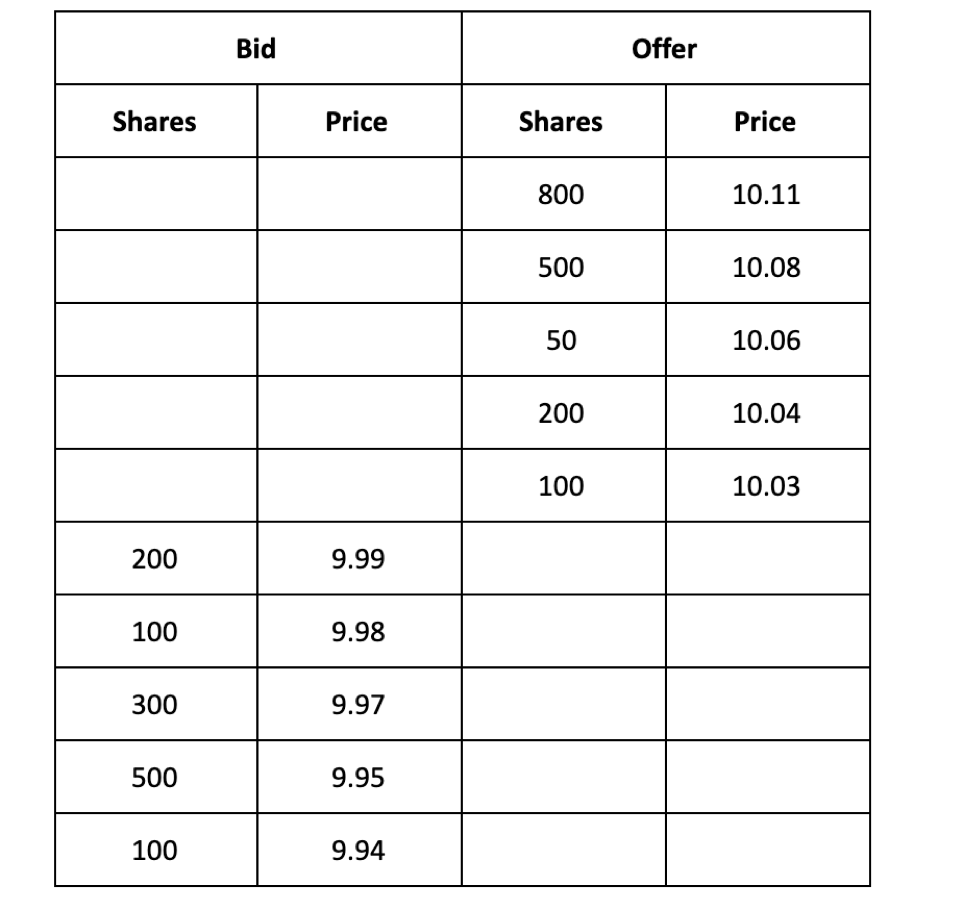
Given the above order book, provide an example of an offer that would make one or more bids execute. For example, “An order to sell X shares at $Y arrives.”
Q2: Calculate the Execution Price(s)
Using your imagined offer, explain which bid or bids execute and the execution price. Review Calculating Execution Prices if necessary.
For example, “The bid for X shares at $Y would immediately transact with the offer for A shares at $B and both bid and offer would immediately disappear.”
Q3: Analyze the Effect of Fragmented MarketsYou should now have a better sense of order book operations. Remember that there are multiple markets, each with their own priorities and rules. In your opinion, what kind of problems can occur when multiple markets each have their own variations of price-time-visibility rules? How might those different priorities and rules affect the construction of a limit order book?
Exercise 2
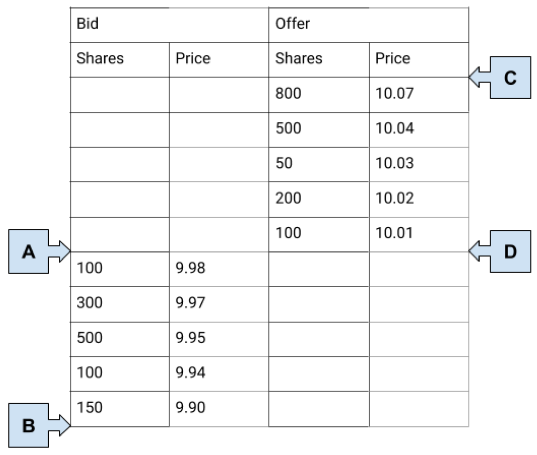
Imagine a new order to buy 200 shares at $10.00 arrives. Where does it enter the order book?
1. Position A (top of bid column)2. Position B (bottom of bid column)3. Position C (top of offer column)4. Position D (bottom of offer column)In the above order book, which order is considered the top-of-book offer?
1. order to sell 50 shares at $10.032. order to sell 800 shares at $10.073. order to sell 100 shares at $10.014. order to buy 100 shares at $9.98